
Most of us have heard this advice many times: eat real food.
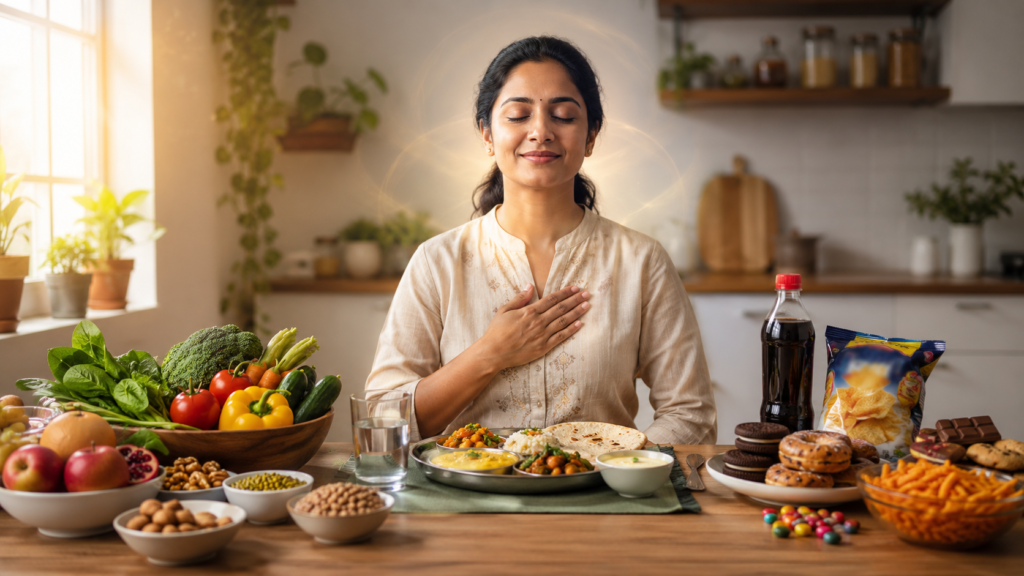
The Dietary Guidelines for Americans, recently released by the United States Department of Agriculture, open with a clear and simple message. Eat natural / real food. Avoid processed foods. Cut down on added sugars. Prefer home-cooked meals.
This is especially so for those with diabetes as ultra-processed foods or UPFs have been found to cause inflammation in the body, which is one key reason for diabetes and other chronic ailments.
On paper, this sounds sensible and achievable.
Yet many people, including those who are well informed about health, still struggle to reduce their intake of UPFs. These foods account for over half of daily caloric intake in the US. In India, UPF retail sales grew at an alarming rate, from $0.9Bn in 2006 to $38Bn in 2019. India’s health indicators reflect the consequences – obesity has doubled over the past two decades and Type 2 diabetes affects one in 10 adults.
So an important question arises – “If we already know what to eat, why is it so difficult to follow through”?
The Missing Link: How Do We Overcome Food Addiction?
Most dietary advice focuses on what to eat and what not to eat. Much less attention is given to how one can overcome the pull of processed foods.
UPFs are designed to be convenient, tasty, and easy to consume. Over time, they can become habits, and for some people, something closer to an addiction.
This is where meditation enters the discussion, not as a spiritual practice, but as a practical tool to understand and work with habits and cravings.
One form of meditation that has been studied in the context of addiction is Vipassana.
What Vipassana Says About Addiction
According to research by the Vipassana Research Institute, addiction does not arise from something inherently addictive outside us. It arises from our own internal experience.
The explanation is simple.
When a person consumes a substance – a drug, alcohol, or even certain foods – a biochemical process begins in the body. This process creates sensations. These sensations are pleasing and so the mind likes these sensations.
From there, a sequence develops:
- Liking leads to craving.
- Craving leads to habit.
- Habit, over time, becomes addiction.
In this view, addiction is a continuum. It is not limited to drugs or alcohol. People get addicted to many things, including sugar, snacks, and comfort foods.
At the core, all addictions are addictions to sensations, or what Vipassana describes as “vibrations” in the body.
Why Sensations Matter
The deepest level of the mind is constantly in contact with bodily sensations. Most of the time, this happens below conscious awareness.
Pleasant sensations trigger desire. Unpleasant sensations trigger aversion. We react automatically, often without noticing what is happening inside us.
Vipassana works by bringing awareness to these sensations. When sensations are observed calmly and with equanimity, without trying to suppress or indulge them, the habit of reacting slowly weakens.
Over time, this awareness can reduce addiction at the subconscious level.
Starting with Anapana
Traditional Vipassana practice requires a ten-day introductory course. While this can be a valuable experience, it may not be immediately practical for everyone.
The good news is that one can begin with Anapana, the preparatory practice for Vipassana.
Anapana is simple, gentle, and accessible. It does not require belief, imagination, or special equipment. It is a practice of awareness.
How to Practice Anapana
Anapana is the practice of observing the natural breath. Here is how you can begin:
- Choose a quiet place
Sit in a comfortable position. You can sit on a chair or on the floor. Keep your back straight but relaxed. - Close your eyes
Cut off awareness of the outside world so that you can focus on your breath. If you wear spectacles, take them off. - Observe your natural breath
Do not control the breath. Do not make it deeper or slower. Let it be exactly as it is. - Focus on a small area
Place your attention on the area below the nostrils and above the upper lip. Notice the touch of the breath as it comes in and goes out. - When the mind wanders, gently return
The mind will wander. This is normal. Each time you notice it, calmly bring your attention back to the breath. - Start small
Begin with five minutes a day. If comfortable, increase to ten minutes. Regular practice is more important than longer sessions.
For greater clarity on how to do Anapana, you could watch this video. https://www.youtube.com/watch?v=Oh5ii6R6LTM
How This Relates to Food Habits
With regular practice, Anapana trains the mind to notice sensations without immediately reacting to them. Instead of reacting automatically, there is a brief pause. In that pause, choice becomes possible.
Encouragement, Not Claims
Meditation does not replace medical care, nutrition advice, or lifestyle changes. It does not claim to cure addiction or eliminate cravings instantly. What it offers is awareness. For many people, awareness is the missing link between knowing what is healthy and actually living it.
If addiction is driven by sensations, and if awareness changes how we react to sensations, then meditation becomes a practical tool for healthier food choices.
A Gentle Beginning
Rather than taking this as a theory, it may help to approach it as an experiment. The idea here is not control, denial, or perfection. It is awareness.
Try Anapana for five minutes a day for one week. Observe what happens, not outside, but inside. Notice how cravings arise. Notice how they pass.
Does awareness change anything? Does it raise new questions?
Sometimes, meaningful change does not begin with willpower or restriction. It begins with quietly observing what is already happening within us.
References:
- “Vipassana Meditation and Drug Addiction.” Vipassana Research Institute, https://www.vridhamma.org/research/Vipassana-Meditation-and-Drug-Addiction.
- “Dietary Guidelines for Americans”, 2025-2030
https://cdn.realfood.gov/DGA.pdf - “Big Food Decides what you eat”, Times of India , Jan 12, 2026
https://timesofindia.indiatimes.com/toi-plus/health/big-food-decides-what-you-eat/articleshow/126466977.cms
(Available only to paid subscribers of The Times of India) - “Scientists are learning why ultra-processed foods are bad for you” The Economist, Nov 25, 2024
https://www.economist.com/science-and-technology/2024/11/25/scientists-are-learning-why-ultra-processed-foods-are-bad-for-you